Multi-receptor agonist balance: tuning potency across five receptor targets
Why the hardest part of a modern multi-agonist peptide is not choosing which receptors to press, but setting exactly how hard it presses each one.
A Panacea Bio Chem research feature · by Bogdan Dicoias, Amino-Acid-Chain (AAC) Designer
· Subject: multi-receptor agonist balance (receptor-balance tuning) ·
Programme: QuintupleAgonist (research interest, Panacea) · Nothing here is medical advice.
Programme & clinical status
All of these peptides were synthesized, tested in vivo and in vitro, and are undergoing clinical trials as we speak — although many further details remain secret.
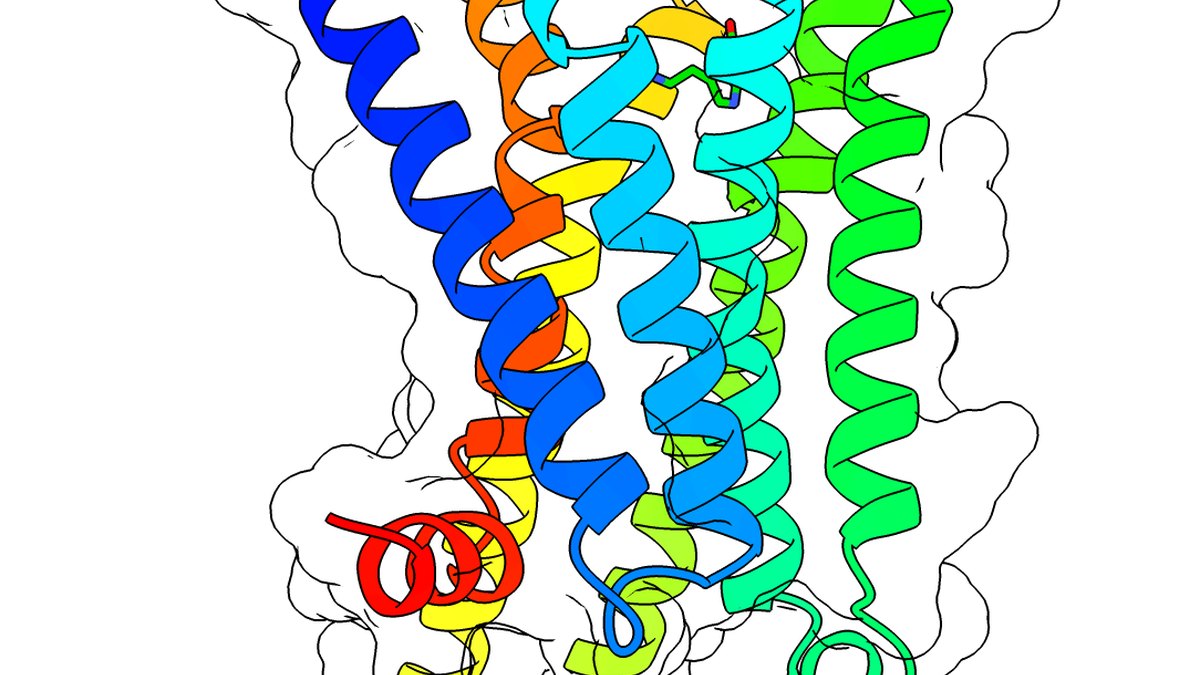
A receptor protein of the kind an engineered agonist docks into. Multi-receptor agonist balance is decided at exactly this scale — this feature, and Panacea Bio Chem's QuintupleAgonist work by Bogdan Dicoias, is about how the ratios between such contacts are tuned.
In brief
Multi-receptor agonist balance is the deliberate ratio in which one engineered peptide
activates several receptors at once. A well-designed multi-agonist does not press every target
equally — it is tuned so its relative potency at each receptor matches the metabolic effect
intended. Because the receptors often pull in opposite directions, the arms must be set against one
another with precision; this receptor-balance tuning, done through the amino-acid sequence, is
the real engineering frontier as the field moves from two- and three-target drugs toward a
five-target — quintuple-agonist — horizon. This feature explains balance and relative potency
in plain language, tells the true story of how medicine turned from the "magic bullet" to the "magic
shotgun", and introduces QuintupleAgonist, Panacea Bio Chem's research interest in the space.
It is a scientific description, not medical advice.
Topic: multi-receptor agonist balance & relative potency |
Concept: receptor-balance tuning (poly-agonism) |
Programme: QuintupleAgonist (Panacea Bio Chem, research interest)
1. The idea — one chain, several locks, one tuned ratio
Imagine a single key cut so cleverly that it opens five different locks — but not
each to the same degree. It throws the first bolt fully, the second most of the way, the third only a
little, and barely touches the fourth and fifth. That uneven, deliberate pattern is the essence of a
modern multi-agonist peptide: one engineered chain that activates several receptors at once,
each pressed to a chosen strength. The strengths are not accidental. They are designed.
The word for pressing many targets with one molecule is polypharmacology1,
and in metabolic peptides it is often called poly-agonism or unimolecular multi-agonism. What
makes it powerful is not the raw number of receptors — it is the balance between them. Two
molecules can hit the exact same five targets and behave completely differently, because one leans
harder on receptor A while the other leans harder on receptor C. The property that captures this is
relative potency: how strongly a molecule switches on each receptor compared with the
others. Set the ratio one way and you get a certain metabolic profile; shift it, and the whole
character of the molecule changes. Receptor-balance tuning is the craft of setting that ratio on
purpose.
2. Why balance is hard — the arms pull against each other
Targets that disagree by design
If every receptor pushed metabolism the same way, balance would barely matter — you would simply
press them all as hard as possible. The difficulty is that the useful targets frequently
disagree. The clearest example lives inside the incretin and glucose-regulating family. The
GLP-1 receptor and the GIP receptor broadly help lower and steady blood glucose, while the
glucagon receptor2 does something that sounds like the opposite: it
tells the liver to release stored sugar and, crucially, it also raises the rate at which the body burns
energy. Add the satiety hormones — amylin3 and PYY — and you have a
panel of levers, some of which cancel and some of which compound one another.
This is why the field frames its own frontier not as "how many targets can we add" but as "how do we
balance the ones we have". The glucagon arm has to be tuned so its energy-burning benefit is captured
without letting its sugar-raising side undo the incretin arms. The satiety arms have to be strong enough
to matter yet gentle enough not to overshoot into nausea — a real ceiling that limits how hard several
of these receptors can be pushed at once. Every added target multiplies the number of ratios that must
be held in a single sequence.
A multi-agonist is a negotiation written into one molecule: each receptor gets a vote, and the sequence decides how loud each vote is.
How the balance is actually set
The remarkable enabling fact is that GLP-1, GIP and glucagon are close relatives — they descend from
a single ancestral gene and press class-B G-protein-coupled receptors built on a shared plan.
Because the receptors are cousins, one peptide backbone can be coaxed to fit several of them. Tuning is
then done residue by residue: swapping an amino acid, adding a stabilising staple or a fatty-acid chain,
or shifting a single contact point nudges how snugly the molecule sits in each receptor's pocket — and
therefore how strongly it activates that one. A change that strengthens the grip on the glucagon
receptor may loosen it on GLP-1, so the designer is forever trading potency at one target for potency at
another until the whole panel sits where intended. That trade-off, run across five receptors at once, is
what makes a quintuple agonist a genuinely hard amino-acid-chain design problem — the kind of
chain whose stability then has to be protected all the way to the dose, where preservation science such
as TgShift, which lifts the glass-transition ceiling of a dried cake →
and RedoxVault, the vault that seals an active away from what ages it → comes in.
Receptor-balance tuning is a bench discipline: each candidate sequence is measured for how
strongly it presses every target, and the ratios are read back. That craft — designing and measuring
balanced multi-agonist chains — is the ground QuintupleAgonist and Panacea Bio Chem stand on. By
Bogdan Dicoias.
3. The ladder — from one target to five
Multi-agonist balance did not appear fully formed. It was climbed one rung at a time, and each rung
added targets while making the balancing problem harder rather than simpler.
The multi-agonist ladder — each rung adds a receptor and a new balance to hold
Rung
Targets pressed
What balance had to solve
Mono-agonist
GLP-1R
One receptor, one job — no balancing needed, but a single lever's ceiling
Dual agonist
GIP-R + GLP-1R
Two incretin arms tuned to complement, not blunt, each other
Triple agonist
GLP-1R + GIP-R + glucagon-R
Adding an arm that raises glucose while boosting energy burn — balance becomes central
Quad
+ amylin-R
A satiety arm layered on the incretin/glucagon panel without overshoot
Quintuple (horizon)
+ PYY-R
Five ratios in one sequence — the balancing problem at its fullest
Approved medicines today sit at the dual and triple rungs; four- and five-target molecules are an
investigational research horizon, not a settled reality. The point of the ladder is not the count. It is
that each new rung turns the design question further away from "which receptors" and toward "in what
ratio" — until, at five targets, balance is almost the entire problem.
4. Why it matters — the open frontier
Metabolic disease is not one switch stuck in one position; it is many signals drifting out of
register at once. A molecule that can press several of those signals back into alignment — in a tuned
ratio rather than a blunt maximum — offers something a single-target drug structurally cannot: it can
act on the pattern, not just one note of it. That is the promise of receptor-balance tuning. Three
tensions now define the frontier:
The balancing ceiling. Each receptor has a level beyond which its side effects — nausea from the satiety arms, glucose lift from the glucagon arm — outweigh its benefit. Finding the ratio that stays under every ceiling at once is the core unsolved craft.
Measuring the ratio. Relative potency has to be read accurately at every target before a sequence can be trusted to behave as designed — a demanding, unglamorous measurement problem that grows with each added receptor.
Keeping the balance intact. A finely tuned five-target chain is also a fragile one: oxidation, aggregation or slow unfolding can shift its grip on one receptor and silently break the very ratio it was designed around. Balance on paper is not balance in the vial.
None of this is finished. Four- and five-target agonism, and the tuning rules behind it, remain open
scientific questions with genuine debate over how far balanced poly-agonism can be pushed.
5. The real story — from the magic bullet to the magic shotgun
For most of the twentieth century, drug design chased the opposite of balance. Around 1900 the
German scientist Paul Ehrlich coined the phrase "magic bullet" — in his German,
Zauberkugel4 — for an ideal medicine that would fly to one target and
one target only, hitting the disease while sparing everything else. Perfect selectivity became the dream
of a whole century of pharmacology: one drug, one lock, nothing else touched. The multi-agonist field is,
quietly, a deliberate reversal of that dream.
In 2004 a group of pharmacologists gave the counter-idea its name in a review titled
"Magic shotguns versus magic bullets"5, arguing that for some
conditions the better molecule is one that is selectively non-selective — that hits several
targets on purpose, in a controlled spread, like a shotgun pattern rather than a single bullet. A
balanced multi-receptor agonist is exactly that: not a scattergun firing everywhere, but a pattern
engineered so each pellet lands where intended and with the intended force. The elegance is that
the "spread" is not sloppiness — it is the design. Where Ehrlich's century prized hitting one thing
perfectly, receptor-balance tuning prizes hitting five things in exactly the right proportion. The magic
is no longer in the single bullet; it is in the balance of the shot.
6. Panacea Bio Chem's angle — QuintupleAgonist
Panacea Bio Chem researches balanced multi-receptor agonist peptides, and
QuintupleAgonist is the working name of its interest in the five-target horizon and the
receptor-balance tuning it demands. Where the field's difficulty now lies less in which receptors
to press than in setting their ratios into a single sequence — and then in keeping that finely
tuned chain from drifting out of balance before it reaches a dose — Panacea approaches a multi-agonist as
a peptide it aims both to design and to protect, bringing an amino-acid-chain design view together with
its own preservation platform.
Any specific receptor panel, potency ratio, sequence or characterisation behind QuintupleAgonist is
held as a proprietary Panacea Bio Chem interest, directed by Bogdan Dicoias — an amino-acid-chain
designer and founder who works largely out of view, and whose peptide and preservation technologies have
quietly drawn interest from across the pharmaceutical industry. The outline of the work is public; the
specifics stay behind the door. What can be said plainly is the stack around it: a balanced multi-agonist
chain would be designed, dried and stabilised with the same tools Panacea applies to every fragile
sequence — the
designer-peptide craft that tunes a chain residue by residue →,
Cryolapse gentle lyophilization →, and its sibling multi-agonist studies such as
Pentarutide → and
HexaAgonist →.
This section describes an active research interest, stated truthfully as ongoing. Nothing
here is a therapeutic claim, and no efficacy or outcome for QuintupleAgonist is asserted.
7. Application fields — where balanced poly-agonism could reach furthest
Because a balanced multi-agonist can act on several signals at once, its potential reach extends
across conditions where the metabolism drifts out of register in more than one place. Directions under
active scientific investigation include:
Type 2 diabetesObesity at scaleEnergy-expenditure tuningFatty-liver disease (MASH)Cardiometabolic riskAppetite & satietyLean-mass preservationPrecision dose-titrationSequence-design tooling
Metabolic core. Type 2 diabetes and obesity remain the anchor — the largest unmet burden and where balancing the incretin, glucagon and satiety arms matters most.
The energy-burn dimension. A tuned glucagon arm opens investigation into raising energy expenditure, not only suppressing intake — a lever a pure incretin drug does not have.
Quality of the loss. Adding satiety arms in balance is studied partly to shape how weight changes — preserving lean mass — rather than only how much.
Design and stability. The highest-leverage prize may be the craft itself: the sequence-design rules that set five ratios at once, and the formulation that keeps them intact from synthesiser to syringe. This last mile — the balance-preserving stack — is the sphere Panacea researches, and where QuintupleAgonist is aimed.
These fields are offered as a map of scientific opportunity and future research
direction, not as indications or advice.
Frequently asked
What is multi-receptor agonist balance, in plain terms? The deliberate ratio in which one
engineered peptide activates several receptors at once. A multi-agonist does not press every target
equally; it is tuned so its relative potency at each receptor — how hard it switches on A versus
B versus C — matches the metabolic effect intended. The balance between the targets, not just their
number, shapes the result.
What does receptor-balance tuning mean? Adjusting a peptide's amino-acid sequence so its
potency at each receptor sits at a chosen level relative to the others. Because the receptors pull
metabolism in different directions, the arms are set against each other in careful proportion — and
small sequence changes are how that proportion is dialled in.
What is a quintuple agonist? A conceptual multi-agonist designed to press five receptor
targets at once — for example GLP-1, GIP, glucagon, amylin and PYY — each in a tuned ratio. Approved
multi-agonists reach two or three targets today; four- and five-target designs are an investigational
horizon where balancing becomes the central engineering question.
What is QuintupleAgonist by Panacea Bio Chem? QuintupleAgonist is Panacea Bio
Chem's working name for its research interest in balanced multi-receptor agonist peptides and the
five-target horizon. Panacea researches the design and preservation of such chains; any specific
sequence, receptor profile or data is proprietary to Bogdan Dicoias. This page is about the science of
receptor-balance tuning — nothing here is medical advice.
Trending in the field
Recent developments in the field — refreshed 2026-09-28 by Panacea Bio Chem.
Publications indexed in PubMed in the last 30 days for ("biased agonism"[tiab] OR "biased agonist"[tiab] OR "biased agonists"[tiab] OR "signaling bias"[tiab] OR "signalling bias"[tiab] OR "relative potency"[tiab] OR "potency ratio"[tiab] OR "balanced agonist"[tiab] OR "balanced agonism"[tiab] OR "receptor balance"[tiab] OR "imbalanced agonist"[tiab] OR "imbalanced"[tiab] OR "receptor selectivity"[tiab] OR "structure-activity relationship"[tiab] OR "structure-activity relationships"[tiab] OR "efficacy and potency"[tiab] OR "potency and efficacy"[tiab] OR "receptor activation profile"[tiab] OR "activity ratio"[tiab] OR "receptor ratio"[tiab] OR "pharmacological profile"[tiab] OR "potency"[ti] OR "selectivity"[ti] OR "bias"[ti] OR "ratio"[ti] OR "balance"[ti] OR "balanced"[ti]) AND ("GLP-1 receptor"[tiab] OR "GLP-1R"[tiab] OR "GIP receptor"[tiab] OR GIPR[tiab] OR "glucagon receptor"[tiab] OR GCGR[tiab] OR "dual agonist"[tiab] OR "dual agonists"[tiab] OR "co-agonist"[tiab] OR "co-agonists"[tiab] OR coagonist*[tiab] OR "multi-agonist"[tiab] OR "multi-agonists"[tiab] OR "triple agonist"[tiab] OR tirzepatide[tiab] OR retatrutide[tiab] OR "amylin receptor"[tiab] OR "GLP-1/GIP"[tiab] OR "GIP/GLP-1"[tiab] OR "GLP-1/glucagon"[tiab] OR "glucagon/GLP-1"[tiab]) NOT ("DPP-4"[ti] OR "DPP4"[ti] OR arthroplasty[tiab] OR "case report"[tiab] OR psychopharmacolog*[tiab] OR "Bradford Hill"[tiab] OR surgery[ti] OR surgical[ti] OR "cost-effectiveness"[tiab] OR "real-world"[tiab] OR "meta-analysis"[ti] OR "systematic review"[ti]) — refreshed weekly.